
 English
 中文
中文 Suomi
Suomi Français
 Deutsch
 日本語
日本語 한국어
한국어 Polski
 Português
 Русский
 Español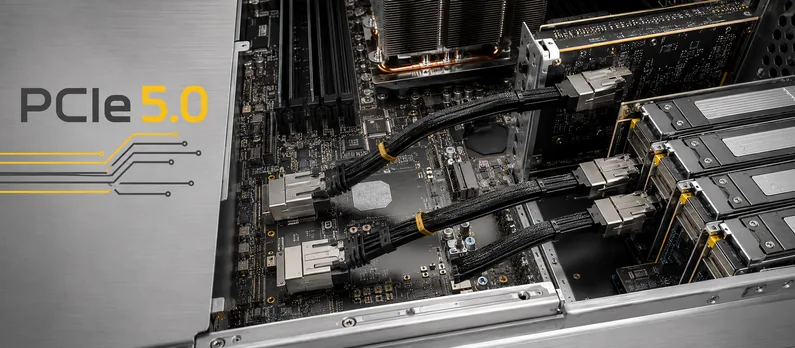
A practical overview of where each interface fits in storage, GPU, riser and internal server architectures.
MCIO is suited to higher lane density and x4/x8/x16 internal links, while OCuLink is commonly used for compact PCIe and NVMe cabling. The connector name alone does not guarantee a PCIe generation or interoperability. Check the applicable SFF definition, lane map, impedance, length, cable exit, latch and host/backplane pinout together.
Primary references: SNIA: SFF-TA-1016
Why this matters
Modern AI, storage and server platforms push both data rate and power density higher. A design that works at one generation or chassis height cannot automatically be carried forward without validating signal, mechanical and thermal margins.
Engineering considerations
Start from the system constraints: target generation, lane count, connector family, cable or trace length, available height, airflow direction, component power and serviceability. These inputs determine whether the best solution is a direct adapter, a cabled architecture, a passive or active heatsink, or a liquid cold plate.
For custom projects, provide drawings, motherboard/GPU layout, target TDP and interface requirements early. That usually shortens the path to a workable prototype.
Validation before deployment
High-speed interconnect projects should verify electrical performance and platform compatibility; thermal projects should validate temperature, fan operating point, pressure drop and mechanical loading under realistic system conditions.
Need a platform-specific recommendation? Contact Hyzocool.