
 English
 中文
中文 Suomi
Suomi Français
 Deutsch
 日本語
日本語 한국어
한국어 Polski
 Português
 Русский
 Español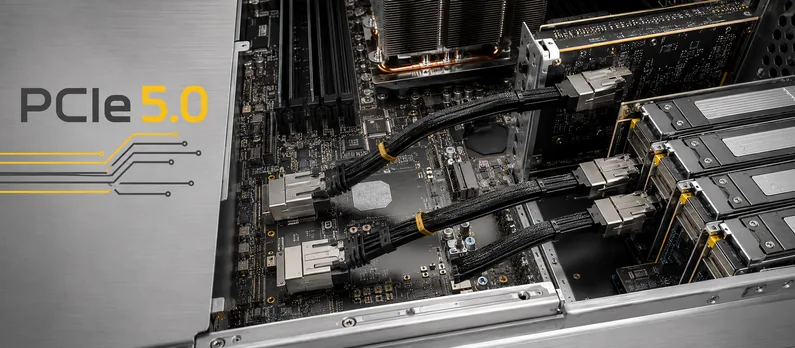
Signal integrity, materials, routing and connector choices become increasingly critical as link speeds rise.
PCIe 5.0 runs at 32 GT/s with NRZ signaling; PCIe 6.0 moves to 64 GT/s PAM4 and adds FLIT mode, FEC and CRC. A real migration is therefore not a connector swap. Channel loss, return loss, crosstalk, PCB material, vias, cable assemblies and retimer placement must be budgeted and validated in the target topology.
Primary references: PCI-SIG: PCI Express 6.0 Specification
Why this matters
Modern AI, storage and server platforms push both data rate and power density higher. A design that works at one generation or chassis height cannot automatically be carried forward without validating signal, mechanical and thermal margins.
Engineering considerations
Start from the system constraints: target generation, lane count, connector family, cable or trace length, available height, airflow direction, component power and serviceability. These inputs determine whether the best solution is a direct adapter, a cabled architecture, a passive or active heatsink, or a liquid cold plate.
For custom projects, provide drawings, motherboard/GPU layout, target TDP and interface requirements early. That usually shortens the path to a workable prototype.
Validation before deployment
High-speed interconnect projects should verify electrical performance and platform compatibility; thermal projects should validate temperature, fan operating point, pressure drop and mechanical loading under realistic system conditions.
Need a platform-specific recommendation? Contact Hyzocool.